Do You Know This Founder?
A Shout-Out for Roger Sherman

A friend of mine recently mentioned he would be traveling to New Haven, Connecticut, and asked me to recommend some sights to see. He knew I had done primary research for my book on Jonathan Edwards at Yale University’s Beinecke Library and thought I might have some tips. He also knew I’m a fan of old cemeteries. I know. Weird.
Well, right across the street from Beinecke Library and Yale Law School is Grove Street Cemetery, filled to the brim with the earthly remains of a Who’s Who of American historical figures. Some notables are Noah Webster (think dictionary), Eli Whitney (think cotton gin), and Charles Goodyear (think rubber tires). But I told my friend, Gary Metzgar, he should make it a point to visit the grave of Roger Sherman.
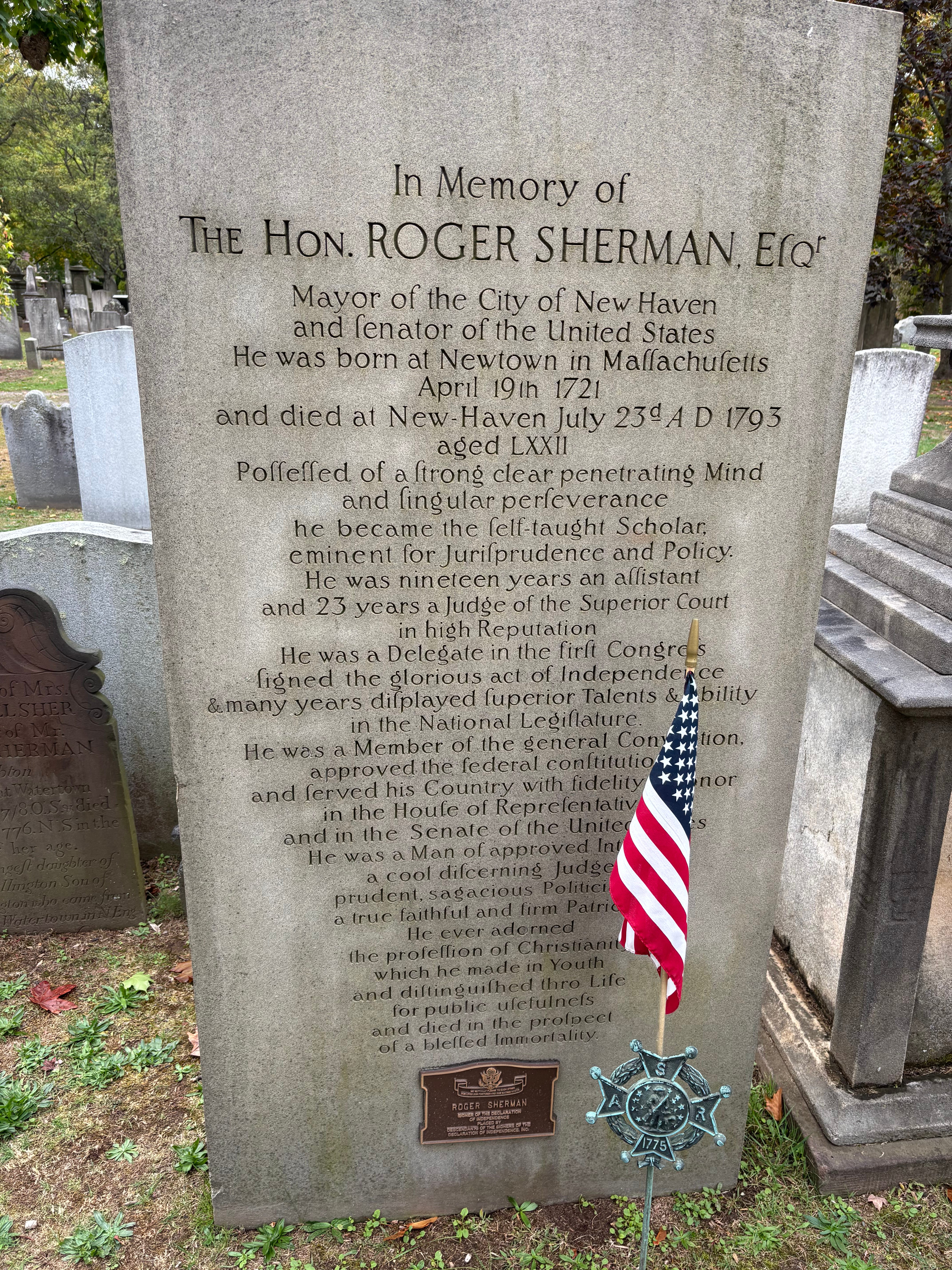
(Photo courtesy of Gary Metzgar)
Who is Roger Sherman?
We’re just nine days away from the 250th anniversary of the Declaration of Independence and we naturally turn our attention to Jefferson, Adams, and Franklin. But sadly, Roger Sherman is often overlooked.
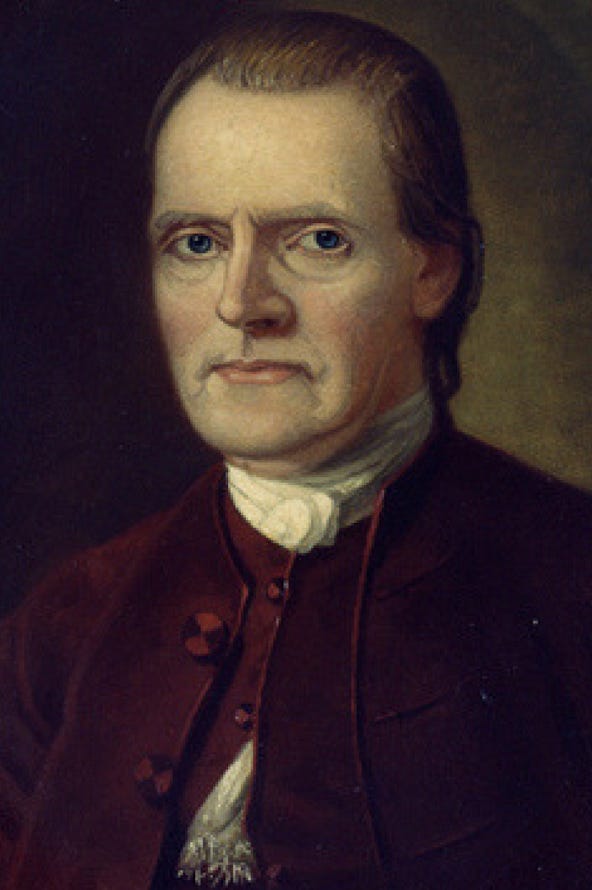
America has four founding documents, and only one man signed all of them: Roger Sherman. You’ll find his signature on the Articles of Association (1774), the Declaration of Independence (1776), the Articles of Confederation (1777), and the United States Constitution (1787). Though he is buried next to Yale University, he never went to college. He was a self-taught scholar who served his community and his newborn country with distinction.
He was a business man in several fields including shoe cobbling, general store owner, publisher, and surveyor. He also served as a Justice of the Peace, a Connecticut Superior Court judge, the mayor of New Haven, and a delegate to the Continental Congress. Notably, he served on the Committee of Five, which was tasked with drafting the Declaration of Independence. In 1787, he was a delegate to the Constitutional Convention. After the Constitution was ratified, he served as a U.S. Representative and then a U.S. Senator.
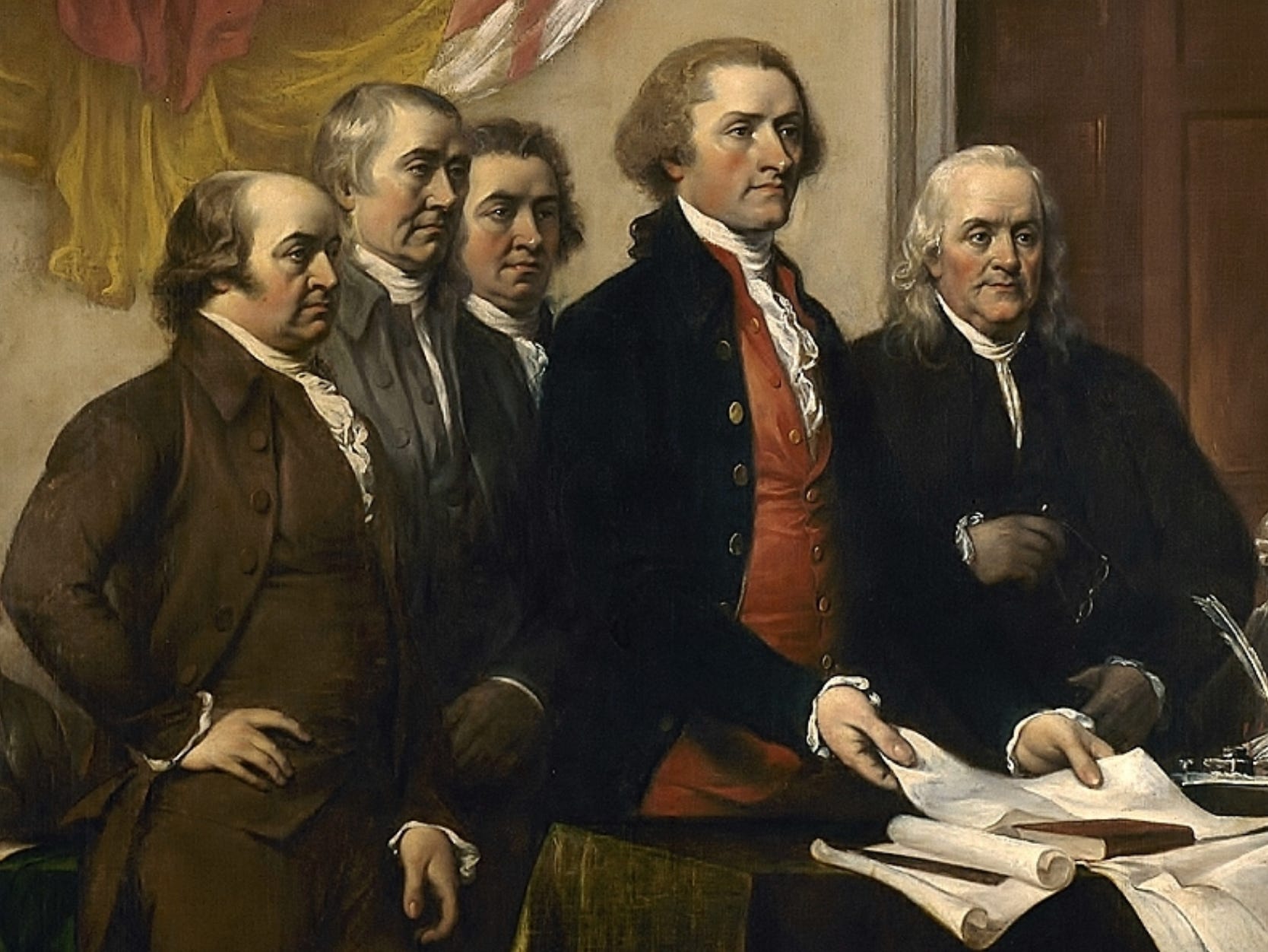
(A zoom-in on John Trumbull’s painting of the Committee of Five: (L to R) John Adams, Roger Sherman, Robert Livingstone, Thomas Jefferson, Benjamin Franklin)
The Connecticut Compromise
Crafting the United States Constitution was a complicated task. For four months, spanning the hot summer of 1787 in Philadelphia, 55 delegates from 12 of the 13 states (Rhode Island sent no delegates) discussed, debated, fought, and fussed over the architecture of the new United States government. They eventually reached an impasse. The larger states wanted representation in Congress to be based on each state’s population, while the smaller states wanted equal representation. The larger states feared that inordinate power would be given to the minority, while the smaller states feared being controlled by the majority.
The impasse was broken when Roger Sherman introduced the Connecticut Compromise. He proposed that Congress be divided into two houses or chambers, with the House of Representatives based on the population of the states and the Senate consisting of two representatives from each state, regardless of size. The Connecticut Compromise was adopted on July 16, 1787. Sherman’s plan broke the deadlock and saved the Constitutional Convention.
“He Ever Adorned the Profession of Christianity”
In all these endeavors, Sherman maintained an impeccable reputation. He attributed this to the grace of God. His profession of faith in Christ stands out among the founders.
“Among the major founders,” writes historian Nathan Finn, “there were relatively few examples of overtly traditional Christians.” Don’t look for models of Christ-followers in Thomas Jefferson, Ben Franklin, John Adams, or Alexander Hamilton. James Madison and George Washington saw the importance of religion but, if they loved Jesus, they seemed to want to keep that a secret.
However, there are several founders who believed the gospel and were not ashamed. These include Samuel Adams, John Jay, Patrick Henry, Elias Boudinot, John Witherspoon, and, of course, Roger Sherman. Sherman was a solid Calvinist who had been heavily influenced by Jonathan Edwards. Professor Mark David Hall has made the case that through founders like Sherman, “Calvinism played a very significant role in shaping the American Revolution and U.S. Constitution.”
Thomas Jefferson said that Sherman “never said a foolish thing in his life.” John Adams described Sherman as “an old Puritan, as honest as an angel and as firm in the cause of American Independence as Mount Atlas.” In numerous writings, Sherman confessed his trust in Christ alone, his affirmation of the central tenets of the Westminster Confession of Faith, and his agreement with Jonathan Edwards on important theological matters.
But Sherman didn’t just talk the talk. He walked the walk, following in the steps of Jesus. The closing line of the epitaph on his tombstone confirms his reputation as a credible witness for Christ:
He ever adorned the profession of Christianity which he made in youth and distinguished thro life for public usefulness and died in the prospect of blessed immortality.
A part of my motorcycle riding is journeying to find and visit old cemeteries. Many have interesting epitaphs however the hook for me is thinking about that person and wondering about the times in their lives corresponding with the dates they lived. Good article.
Thanks for sharing such a testimony!