What Made America Great
It Wasn't The Smartphone

In 1985, Neil Postman released his book, Amusing Ourselves to Death: Public Discourse in the Age of Show Business. I was a youth pastor, and part of my job was to be an expert on youth culture, so I bought the book, read the book, and kept the book. I still have it in my personal library 41 years later. It wasn’t specifically about youth culture but about the forces at work in American culture as a whole. Postman, a professor at New York University, died in 2003, but his book still sells well and as of today it is still #1 in the “Media and Internet Politics” category on Amazon. Why? Because Postman predicted the future we are living today.
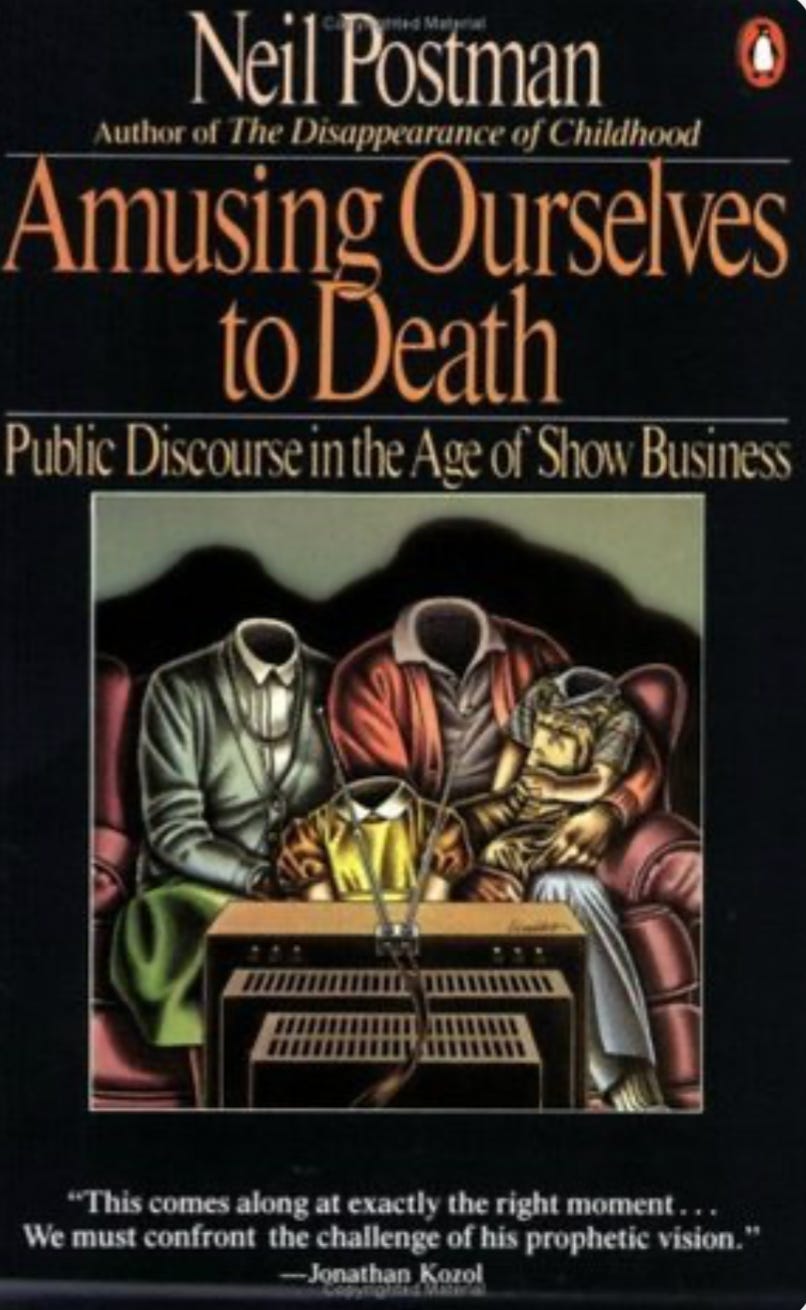
In 1985, Postman observed that public discourse was moving away from the printed word as the main medium to the visual image of television. In short (and at the risk of oversimplifying) television was making us stupid by flooding us with massive amounts of trivial and irrelevant information. On the fortieth anniversary of Amusing Ourselves to Death, Brett McCracken and Ivan Mesa edited Scrolling Ourselves to Death: Reclaiming Life in a Digital Age, in which the authors demonstrate how the warnings Postman issued about television are true about the internet and social media.
McCracken writes,
Postman argued that above all else, television’s function is to gather an audience that can be sold to advertisers. TV exists as an efficient instrument to advance corporate profits by delivering huge audiences of captive eyeballs…American television in particular discovered quickly that the best way to gather an audience was not to responsibly inform and truthfully report but to constantly amuse.
We still have television, but now we have more channels than ever. We have 24-hour news outlets, streaming, YouTube, TikTok, and host of other addictive platforms specifically engineered to capture eyeballs for monetary gain. The result is that our world is flooded with entertaining misinformation and disinformation that breeds impatience, short attention spans, and flawed logic.
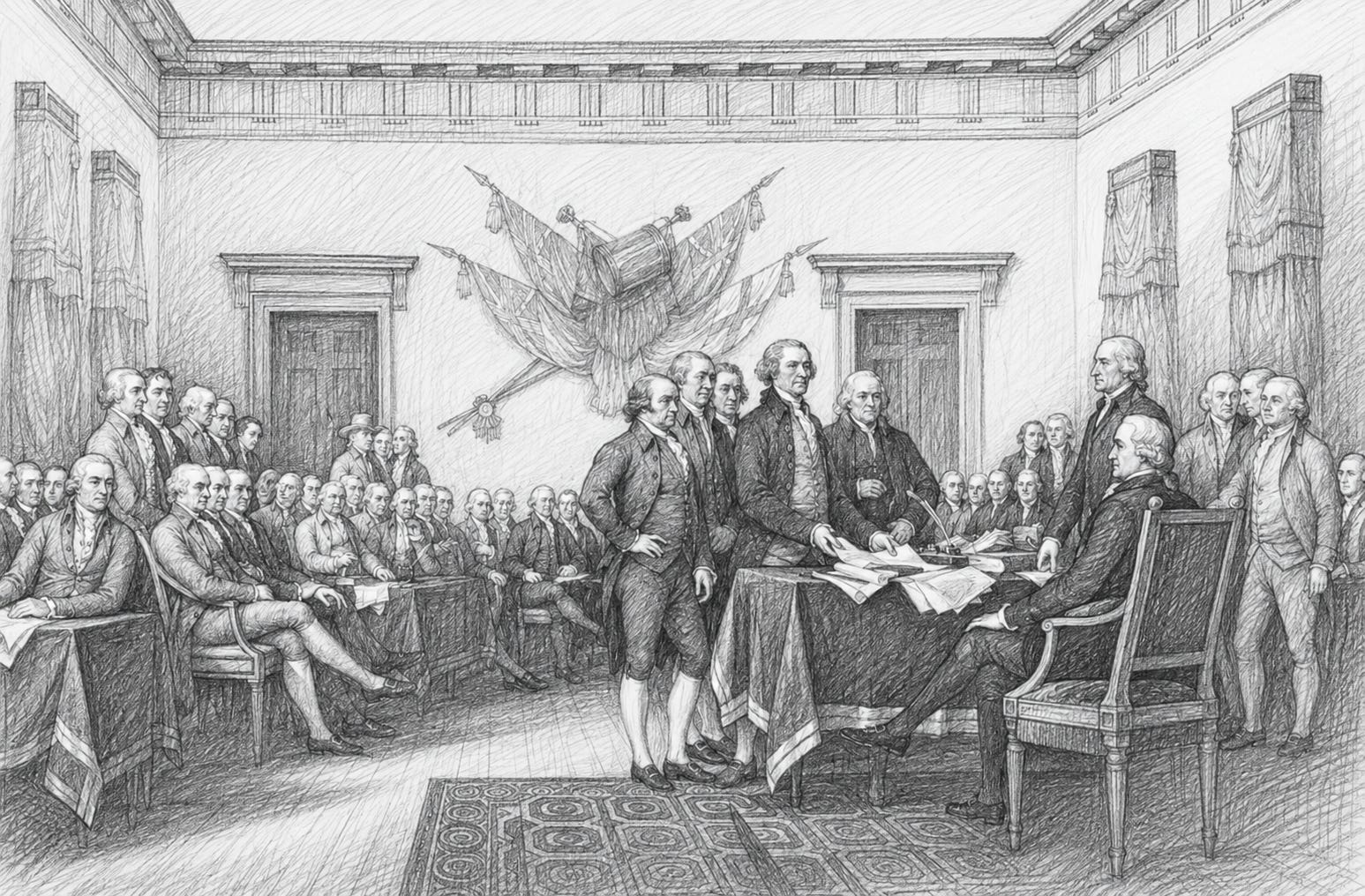
[From John Trumbull’s painting depicting the presentation of first draft of the Declaration of Independence to the Second Continental Congress on June 28, 1776.]
What Our Founders Knew
We are now less than a month away from the 250th birthday of the United States. The brilliance of our Founders is seen in that the government they gave us is built on a realistic view of human nature. The Declaration expresses the truth that we are made in God’s image, “created equal and endowed by our Creator with certain unalienable rights.” At the same time, history proved that we are indeed fallen, and therefore no one can be trusted with much power.
We Live In A Fallen World
John Witherspoon, the president of Princeton College and the only clergy member to sign the Declaration, took issue with Thomas Paine, who had criticized the doctrine of original sin in his work Common Sense. In 1776, Witherspoon wrote of Paine:
Without the shadow of reasoning, he is pleased to represent the doctrine of original sin as an object of contempt or abhorrence…On the contrary, I cannot help being of opinion, that such has been the visible state of the world in every age, as cannot be accounted for on any other principles than what we learn from the word of God, that the imagination of the heart of man is only evil from his youth, and that continually.
One of Witherspoon’s students was James Madison, who would come to be known as the “Father of the Constitution.” Madison adopted his mentor’s pessimistic view of human nature and wrote in the Federalist Papers (#51):
It may be a reflection on human nature, that such devices should be necessary to control the abuses of government. But what is government itself, but the greatest of all reflections on human nature? If men were angels, no government would be necessary.
The Best Governments Recognize Our Fallenness
Therefore, the best government will separate powers and provide an elegant system of checks and balances. That’s why our Constitution divides government into three branches (legislative, judicial, and executive). That’s also why we have a First Amendment. The two institutions best suited to provide additional checks on federal power are the church and the press.
The church must be free to speak truth to power, praising government when it is just, protesting government when it is unjust, and providing moral training for its citizens. The press must be free to report to the people what their elected representatives are up to in order to hold them accountable. The role of a free press is to provide the reliable information citizens need in a government “of the people, by the people, for the people.”
Three Ingredients For a Healthy Constitutional Republic
In short, for a system of self-government like ours to endure, three things have to happen.
First, the people must form families, centered on the lifelong union of one man and one woman who can produce the next generation of productive citizens. These families are the simplest forms of government and the building blocks of a nation. Family is the primary mediating institution that puts a check on government power.
Second, the people must be virtuous, knowing right from wrong and doing what is right in the eyes of God who is “the Supreme Judge of the world,” in the words of the Declaration. Each Founder understood that the Christian ethical system was a necessary ingredient for this republic to thrive, even if they themselves were not orthodox Christians (i.e., Jefferson).
Third, the people must be literate. A free press is of no use to people who can’t read. The ability to read with comprehension is a necessary requirement of self-government. People who can’t or won’t read are at the mercy of those who can and will. Political and theological debates were largely carried out in print in 1776 and the printed word is less forgiving of factual errors and logical fallacies than the visual images of television and the internet. Printed words make you think. Images make you feel. Deep and lateral reading is necessary to develop critical thinking skills and if people are to govern themselves, they must be well informed and clear thinkers. Otherwise, they will elect entertainers who can amuse them rather than statesmen who can lead them.
In 1985, Postman saw these three things slipping away under the sway of television. Today we are seeing even greater slippage under the sway of the internet.
How the Smartphone Can Undermine A Nation
There is an enormous and growing body of evidence that smartphones are a double-edged sword that can do much good and also much damage. But there is a mounting consensus that smartphones, like chainsaws, Jack Daniels, and the steering wheel of your car, don’t belong in the hands of children. Yet we have filled the hands of our children with smartphones. Smartphones can undermine a nation in three ways.
1. By Contributing To a Declining Birthrate
Correlation is not causation but it’s hard to ignore the fact that “smartphones arrived just before the US fertility rate plunged.” Recent research has linked Apple's introduction of the iPhone in 2007 to fewer babies. Researchers theorize that the obsession with the phone, texting, and social media changed the way people relate to each other, isolating them, decreasing face-to-face interaction and replacing it with online interaction. Over time, a whole generation began losing social skills, especially in relating to the opposite sex. The I-phone, says Ross Douthat, “drove men and women apart,” contributing to the decline in the marriage rate. As one researcher said, “People are all depressed and alone and doomscrolling.” There are other factors that help explain the decreased birthrate, but this one shouldn’t be overlooked.
2. By Contributing to Moral Confusion
In terms of training in virtue, the last place to look is on the internet. In the same way that Neil Postman saw television undermining the traditional role of parents as arbiters of knowledge and moral training, social media does so today. The proliferation of internet pornography makes virtual relationships a sad and lonely substitute for real relationships. A generation of young men are being taught to use and objectify women, or at least their images, while never developing the moral character and social skills required to be a good husband and father.
Lying, cheating, slandering, rumor-mongering, stealing, plagiarizing, boasting, outrage, insults, and profanity are all simply the stuff of social media interactions. These are the kinds of things that America’s Founders abhorred. In his Rules of Civility and Decent Behavior, George Washington advised, “Be not hasty to believe flying reports to the disparagement of any.” How quaint.
3. By Contributing to Functional Illiteracy
As for reading with comprehension, fewer Americans know how to do it. In fact, if you have read this article to this point, I’m impressed. In general, the more time students spend on their smartphones, the less skillful they are in reading and writing. When smartphones, laptops, and other screens are removed from the classroom, reading ability improves. Only 14% of teenagers now say that they read for fun, down from 27% in 2012. In 1992, it was 37%. Why the decline in time spent reading? The rise of social media use on cellphones. Instead of reading books, which requires sustained thought and mental discipline, it’s much easier to feast the eyes on images and videos designed to make impressions, stir passions, create addictions, and bypass critical thinking.
What Postman Predicted
So there you have it. Our nation is almost 250 years old, but to sustain our system of self-government, our nation needs its citizens to form families, practice Christian virtue, and read with comprehension. If our enemies wanted to weaken us, one way they could do it is to give Americans, especially our younger generation, smartphones. But our enemies don’t need to do that because we have already done it to ourselves. Any effort to make America great again that ignores the crucial necessity of forming stable families, practicing virtue, and reading with critical comprehension will fall far short of its objective.
Neil Postman saw this coming in 1985.
The unbeliever says it’s gone to far, nothing can reverse or change the downward trend, but the believer says his God can separate sky and water, create and populate a planet and move any mountain to protect his people.
Witherspoon would be proud. If you had been born during that era I bet we would see "S. Bateman" elegantly signed on the Declaration.